Divorce papers in one hand. Social services forms in the other. A six-figure job vanished overnight.
This isn’t the beginning of a tragedy. It’s the origin story of a healthcare revolution.
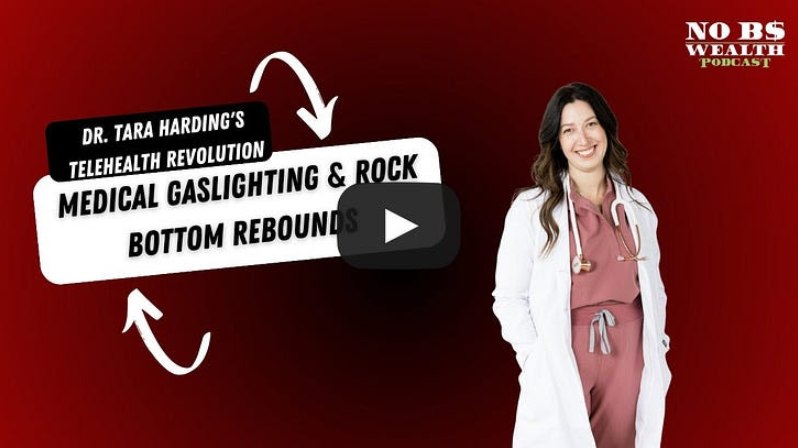
I recently interviewed Dr. Tara Harding for my podcast, and her story left me speechless. It’s the perfect storm of personal crisis meeting professional awakening—with women’s health caught in the crosshairs.
When the System Fails You, Build Your Own
“I went from a six-figure total comfort… to, oh my gosh, what am I gonna do financially,” Dr. Harding recalled, describing the moment her hospital job abruptly ended. “I’m the primary income maker of the family.”
Six months later, her husband asked for a divorce.
Rock bottom? Absolutely. But instead of crumbling, she made a calculation many of us would never dare: she gave herself 90 days to make her fledgling telehealth business work before submitting those social services forms.
“Today, I am up to 10 providers in my clinic. We are serving four states via telemedicine and growing. We’re pediatrics, mental health, men’s health, hormones, infertility. We are everything now—a full scope private practice clinic.”
But this isn’t just a success story about perseverance. It’s about identifying a massive, dangerous gap in healthcare and having the courage to fill it.

The Silent Epidemic of Medical Gaslighting
Here are some statistics that should enrage you:
Women are diagnosed with cancer four years later than men
Women receive 25% less pain medication in emergency rooms than men
Eight out of ten women complaining of physical symptoms are referred to mental health services
This phenomenon has a name: medical gaslighting.
“A lot of things are like ‘if you just lose weight’ or ‘if you just gain weight,’” Dr. Harding explained. “You know, the woman’s too small, then she’s too big, or ‘it’s normal for your age’ when the reality is a lot of research and data has changed… and there’s a lot of things you can do that are safe and effective that women aren’t even being told about.”
How many women reading this have heard “it’s just anxiety” or “this is normal” when their body was screaming that something was wrong?
The Telehealth Revolution We Desperately Need
What makes Dr. Harding’s approach revolutionary isn’t just that it’s virtual—it’s about creating a fundamentally different doctor-patient relationship.
“What telehealth did was provide a comfortable setting for women to really open up,” she explained. “They’d be in their closet, they’d be laying in their bed, sitting on their comfy couch with their blanket on their lap.”
The results were immediate: “My first time meeting with them, I felt like I knew more about them than their provider who has probably seen them for 10 years.”
This isn’t a coincidence. When women feel safe, when they’re in their own environment, when they know they won’t be dismissed—they open up. And when they open up, accurate diagnosis and treatment become possible.
“We always say, ‘You’re in a safe space. There’s no judgment here,’” Dr. Harding emphasized. “With medical gaslighting, we have to really break down some barriers.”
Beyond the Individual: Fighting for Systemic Change
Dr. Harding isn’t just treating patients—she’s fighting for legislative change. Since 2019, she’s been advocating for insurance coverage for infertility treatment and fertility preservation for cancer patients.
The opposition she’s faced is staggering. At a recent legislative session in North Dakota, a female legislator claimed that “infertility is God’s way of condemning women” and that women should “pray more and confess their sins” to cure infertility.
Yes, this happened in 2025.
Dr. Harding’s response? Turn outrage into action. “What I did is I took it a step further and I was like, ‘Here’s what you can do if you think what she did is wrong.’” She created email templates, shared voting records, and mobilized ordinary citizens to speak up.
“Your voice actually matters,” she insisted. “I know people don’t think that their vote or their voice matters, and it really actually does.”
What You Can Do Right Now
Whether you’re facing your own health struggles or simply want to be part of the solution, here are some actionable steps:
Make that appointment—Dr. Harding’s advice is clear: “Make that appointment. Do it again. I don’t care if it’s the eighth or ninth time, do it.”
Build a healthcare team—”If one person thinks they know it all about what’s going on with your health, that’s dangerous stuff,” she warns. Don’t rely on a single provider.
Recognize when it’s time to move on—”We outgrow people too. Just like we outgrow houses and cars and shoes. We outgrow our medical team too, and that’s okay.”
Use your voice—Contact your legislators about women’s health issues. “Even if it’s at your district level, your state level. That matters a lot because a lot of what’s happening on the federal level is actually happening in your own back door.”
Redefine community—As Dr. Harding discovered, true community isn’t geographic. It’s who supports your growth. “A lot of my worth and ability was coming from other voices sometimes… my spouse, my partner, my friend, my coworker, my parents.”
The Bottom Line
Medical gaslighting isn’t just frustrating—it’s deadly. When women’s symptoms are dismissed, serious conditions go undiagnosed. When pain is minimized, suffering is prolonged. When concerns are attributed to anxiety or hormones, real medical issues fester.
Dr. Harding’s journey from crisis to revolution shows us that the system can change—but only if we demand it. Only if we build alternatives. Only if we refuse to accept less than we deserve.
As she puts it: “Your symptoms are real. They are real. You just have to find the right team.”
Are you a healthcare provider or patient with experience with medical gaslighting? Share your story in the comments—your voice matters.
If you found this valuable, please consider subscribing and sharing with someone who needs to hear this message. Together, we can change how women’s health is approached.